 |

 |
Print page |  |
Email page |  |
Login | Register |
Review from the chairperson
 |
|
||||
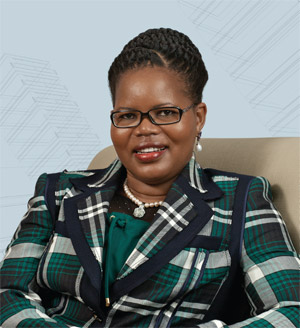
| Philisiwe Buthelezi | * Seven-year compound average growth rate. | ||||
 |



In a difficult year for the construction sector, Group Five adhered to a disciplined and responsible approach to very weak and unpredictable markets. I am proud to report that the management team addressed the many challenges posed by current market conditions, while simultaneously positioning the group for future growth opportunities over an expanded geographic footprint.
-
The macro-economic environment
Global economic recovery has proved more elusive than generally believed 12 months ago, with inflationary pressures and the rising cost of capital likely to dampen public spending and private sector investment in the short to medium term. Although it is disappointing to note that a slower trajectory of global economic recovery is now almost inevitable, the group continues to monitor the variable market conditions through its ongoing risk assessment systems which results in proactive management decisions.
A slower economic recovery has the potential to impact significantly on the group’s markets, creating cost pressures and constraining new business. The group’s response has been to further diversify its sector focus and its geographical base beyond South Africa, where constraints in public spending have had a particularly negative impact on new contract availability during the period. Group Five now has operational experience across 22 countries in Africa, Eastern Europe and the Middle East. During the year, the group focused on reinforcing its strong foothold in Africa, rebuilding its business in the Middle East and seeking opportunities for expansion into other markets where we have the potential to operate and grow.
-
Risk management
Strong governance structures, including the effective management of risk, are essential in navigating the business successfully through the uncertain and potentially volatile economic conditions that we believe still lie ahead.
At Group Five, risk assessment is seen as a critical business function and essential in developing a resilient business culture that is risk aware. In Group Five’s risk management process, key risks at a macro-economic, business and contract level are identified and their potential impact on the group is continually assessed and monitored. Risk management is not seen as a once-off exercise and is integrated into our business processes and decision making.
An example of the group’s approach to managing risk is its decision to proactively engage with the Competition Commission in its investigation into the construction sector. Over the past two years we have worked in close cooperation with the Commission with the aim of expunging historically misguided behaviours from our business

and the industry. We have been granted conditional leniency by the Commission pending the finalisation of the broader industry investigation. We believe this approach will be to the long term benefit of the group and is in keeping with Group Five’s culture of transparency and integrity.
-
Governance
The group remains committed to meeting the requirements of the King Code of Governance (King III).

As reported last year, Group Five manages and reports on financial and sustainability issues in an integrated business model. In this integrated report we have further refined our approach to integrated reporting, as required under King III, by identifying and reporting on the issues which are most material to the group. For the first time we have included reports from the chairpeople of key board committees to strengthen our disclosure on all issues which impact on the group. We welcome feedback on our reporting. This is essential if we are to continue improving in this area.
Our governance protocol includes a board review. An independent review of the board’s performance and capacity was conducted in the year. The review process included peer feedback, structured interviews with each board member and formal individual and group feedback.
The board was found to be running effectively overall, although it was recommended that the board supplements its engineering and legal skills capability. To address these gaps, the board approved the appointment of two additional board members through its nominations committee. They joined the board with effect from August 2011.
-
Transformation, skills development and socio-economic development
I am delighted to record that despite the challenging conditions during the year Group Five has maintained an unwavering commitment to black economic transformation and has shown concrete progress in meeting the provisions of the Construction Charter. Our broad-based black economic empowerment (BBBEE) rating under the Construction Charter improved to a Level 2 contributor. We have been able to achieve this goal despite being in the process of unwinding the ownership transaction undertaken with one of our BBBEE ownership shareholders, the iLima Consortium. In consideration of this unwind the board has mandated management to review and propose a future BBBEE shareholding structure which will be presented to existing shareholders for approval. This process is currently under way.
The broader approach of the group to transformation extends beyond mere compliance and we are now seeing the benefits of this philosophy in the external acknowledgements the group has received.
We currently have the best rating in our sector against the guidelines of the sector scorecard. We have also been rated as the 11th most empowered company in South Africa and the winner in the Basic Industrials Sector by the Financial Mail in its Top Empowerment Companies survey in 2011. Our board comprises a broad spectrum of South Africans, including two black females, one white female, three white males and one black male. The board also comprises three international board members. We are proud of this diversity.
Our socio-economic development (SED) programmes have continued to progress. As we move across the borders of South Africa, this business ethos will continue into the other African countries in which we operate.
We are cognisant of the need to develop the capacity of the technical skills required in our industry and therefore support the government’s National Economic Growth Plan (NEGP). The group has a track record of strong skills development in our business and industry, as well as delivering training and development programmes through our SED initiatives. Refer to page 79 for more information. We believe through these initiatives we will make a tangible contribution to achieving the objectives of the NEGP
-
Future growth opportunities
In South Africa, the need for public sector spending continues to increase in importance. We are optimistic about the potential of the power sector following the announcement by the South African Department of Energy that it will start consulting with interested parties on the next Integrated Resource Plan (IRP2) for the country’s energy future. The timing of the plan’s roll out will be important to ensure traction in delivery.
In the rest of Africa, we believe there is strong potential for growth, particularly in the mining, power and transport sectors. Economic fundamentals underpin strong positive sentiment around Africa’s growth prospects. According to The Economist of January 2011, six African countries were among the top ten fastest-growing countries globally between 2001 and 2010. Capital inflows are forecast to reach US$150 billion per annum by 2015. Africa has a wealth of natural resources in a world that is resource scarce. Most impressively, Africans themselves are leading growth in investment on the continent with African investment in other African countries within a diverse range of sectors and economies increasing by a compound rate of 21% from 2003 to 2010.
Group Five is well positioned to take its place in this new era of African and emerging market growth. Although operating in Africa carries specific risks, these can be managed with proper risk assessment and governance processes. As a group, we have the track record and experience to participate in this “African success story”. We have many years of experience on the continent and a clear operating strategy. We believe that our continuing focus on risk management and governance enables us to expand our business on the continent in a way which will generate sustainable value for shareholders and contribute positively to the societies in which we operate.
In the Middle East and North Africa, careful assessment of market conditions is needed given the combined impact of the global economic crisis and recent popular revolutions in the region. The group has chosen to focus on commercial and financial closure of its cancelled Dubai contracts and to limit its business development activities to a small number of territories which meet the group’s risk policies.
In Central and Eastern Europe, the concessions markets where we operate through our Intertoll brand have experienced a difficult period due to the economic slowdown and a number of political developments. No significant improvement in market conditions can be anticipated before 2012 or 2013. Against this, Intertoll has been able to extend its footprint into alternative markets in the region, including undertaking some contracts in the Balkans.
Looking forward, we believe that the gradual economic recovery will lead to increasing demand in our sector in the medium term, although we expect the tough conditions to be present for much of the financial year ahead.
-
Appreciation
As chairperson of the board, it is my pleasure to extend my appreciation to my fellow board members and to thank them for their support during the year. I thank our shareholders, clients, suppliers and business associates for their continued partnership with and support to the group.
The achievements of the management team at Group Five have been significant in challenging circumstances and I acknowledge their hard work and leadership. A special word of acknowledgment to our CEO Mike Upton and his executive team. Credit must also go to the group’s employees, who have worked as a cohesive team to ensure the business weathers the current storm.
I am also particularly appreciative of the diversity of thinking displayed by my fellow board members and the executive team. I enjoy and value the constructive discussions around issues which affect the future growth prospects of Group Five and the role it plays in the wider context of our country’s economy and society in general.
P (Philisiwe) Buthelezi
Non-executive chairperson5 August 2011