 |
|
||||||||


|
Against tough market conditions, we reviewed the fundamentals of our strategy and operations. This spread outlines interviews with the group’s management team around the key issues that impacted their businesses during the year. |
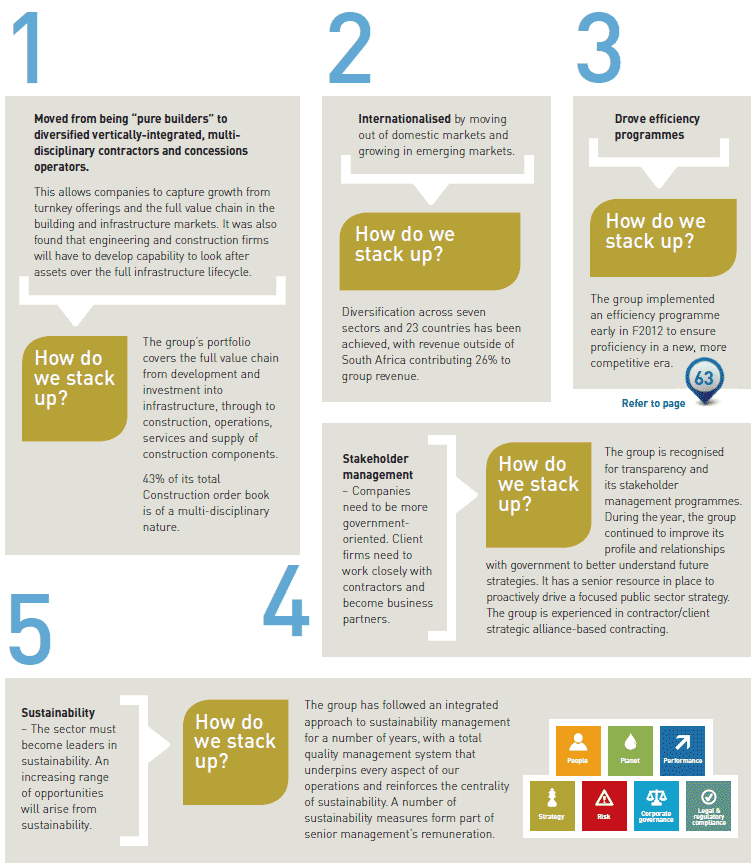
Two leading global financial, strategy and management consulting groups conducted research recently that provided a consensus for the construction sector globally, which included the South African and African context. Both researchers concluded that successful infrastructure companies adopted the following growth strategies:
 |
|
MIKE UPTON Chief executive officer
|
What actions did you take as a management team, especially in view of tough markets? | ||
| We conducted a thorough review of our markets, how we are performing, whether our strategy is relevant and whether our structures support what we need to do. Our review outlined that we needed to be more focused on businesses that address key markets where we have strong expertise and some differentiation as well as where we can add value and manage them through cycles. In addition, the internal fitness and cost effectiveness of the group required an intervention. As outlined on page 64, we therefore restructured the group to ensure alignment with our sector and geographic strategies and to result in more seamless interaction across the group’s businesses.
We focused on lowering the cash and margin drain incurred in F2012 by resolving a number of costly legacies from prior cycles and redundant strategies. This involved initiating the sale of our Construction Materials cluster and micro-managing our Middle East operations. |
 “Management is incredibly
disappointed by the destruction in
shareholder value following the
group’s investment into the
Construction Materials businesses.
Many lessons have been learnt from
this experience, which the group has
used to enhance its mergers and
acquisition methodology and
evaluation processes. We can confirm
that following this refinement,
acquisitions considered in recent
years have been subjected to a more
rigorous and strategic analysis and
opportunities declined when sufficient
comfort on the acquisition could
not be obtained.” “Management is incredibly
disappointed by the destruction in
shareholder value following the
group’s investment into the
Construction Materials businesses.
Many lessons have been learnt from
this experience, which the group has
used to enhance its mergers and
acquisition methodology and
evaluation processes. We can confirm
that following this refinement,
acquisitions considered in recent
years have been subjected to a more
rigorous and strategic analysis and
opportunities declined when sufficient
comfort on the acquisition could
not be obtained.” |
| Our response to the very weak trading conditions was to keep a continuous focus on disciplined bid management and cash management, whilst accepting some carrying cost for specific areas of future growth and retaining capacity ahead of expected contract awards. Carrying costs and capital expenditure needed to be strongly motivated for return on investment and future cash generation. | |||
|
Did you change your strategy to ensure resilience? | ||
| No, but we further refined it. We believe our strategy of being a diversified construction, infrastructure concessions and services group primarily focused on Africa and Eastern Europe, whilst reviewing our presence in the Middle East, is currently correct. | |||
|
What were the hardest lessons you have learnt over the last two years? | ||
| The cyclicality of the market in terms of highs and
lows has been very volatile over the last few years,
in particular in the materials supply chain into
construction. This was one of our hardest lessons,
as we suffered significant operating and investment
losses in our Construction Materials cluster.
We had to evaluate carefully how we operate, as the current market conditions resulted in an increase in smaller value contracts rather than a few large ones, with work spread over a much wider geographic region. This highlighted the need for further centralisation of controls to mitigate risk, reduce complexity and duplication and to operate at a lower cost. We have also refined our diversification strategy proactively in a short time, as at one point we were very reliant on the South African public sector. We now have a much better spread, with over-border work having contributed 26% to revenue during the year and a Construction order book that is 38% focused on work outside South Africa. We are also successfully operating in seven sectors. Pleasingly, the contribution of annuitytype businesses increased in the year, contributing 19% to revenue and 60% to operating profit. This supports our strategy of diversity in the business portfolio as this somewhat mitigates the cyclical nature of construction. This was particularly relevant in a year where we had carrying costs and suffered losses in the Middle East. Lastly, the importance of the basic business management principles has certainly been true over the last few years – having strong risk filters in place, sticking to the basics of cash being paramount and that people are truly your greatest assets. With the refocusing of our business during the year, I believe we have the capacity to handle the changes and challenges the markets will continue to present to us. |
|||
|
Why do you think your business is well placed going forward? | ||
| As a management team we are confident that our
business focus is correct in terms of having concessions
and manufacturing businesses alongside our core
construction, as we require diversification to ensure
growth prospects and returns to shareholders and to
offer a full infrastructure solution.
Cash generation can be volatile in construction, which is smoothed by the annuity-type businesses in concessions, services and manufacturing. We also believe that it provides more counter-cyclicality as it is de-risked from pure construction cycles, which provides more predictable earnings. These returns on investments are maximised when combined with an underlying pure construction business which carries a lean balance sheet and strong working capital opportunities. |
|||
|
What is your internationalisation strategy and what are some of your over-border revenue targets? | ||
| After detailed evaluation, we currently believe our key international markets will remain the rest of Africa and Eastern Europe, with the Middle East under review. A detailed internationalisation strategy was completed and approved by the board. The core focus will remain Africa, with the key strategy to establish a permanent presence in growth regions. This will ensure support to more of the group’s businesses as they expand geographically. The group is re-assessing its goals in terms of the split of domestic versus over-border businesses in the context of weak domestic markets and increasing international opportunities. | |||
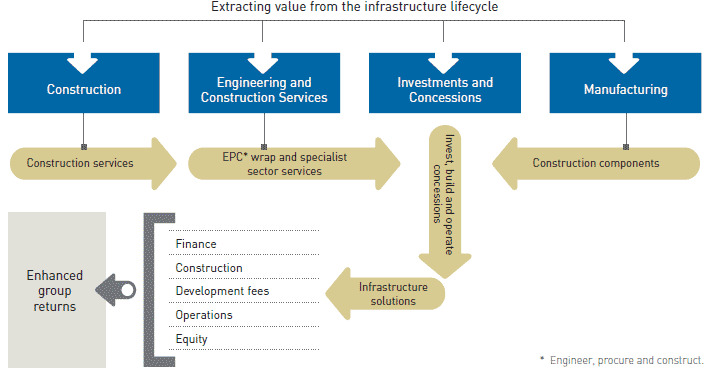
Group Five’s business model ensures it extracts value across the infrastructure lifecycle.
 WILLIE ZEELIE WILLIE ZEELIEExecutive: Engineering and Construction Servicesˇ |
|||
|
You have spoken about an EPC strategy for a while. What have you achieved so far? | ||
| The Engineering and Construction Services (E&CS)
cluster was established in line with the group’s
strategy to expand its offering to include packaged,
turnkey and engineer, procure and construct (EPC)
solutions for specific sectors.
We have been investing in this growth opportunity for two years now with little return due to general market weakness and the long term nature of developing and securing large contracts, as well as the slow progression of the South African independent and renewable energy policies. Pleasingly, our investments are starting to pay off as several significant power and oil and gas contracts have been secured for trading in F2013. In support of servicing across the infrastructure lifecycle, E&CS is also building its services and maintenance capabilities to provide long term support aligned to the construction of plants. Our order book now reflects orders in the power sector for thermal, nuclear and wind and solar renewable power, as well as oil and gas services and tankage contracts. The E&CS order book has a good over-border component at 34%. |
|||
|
What progress have you made on nuclear? | ||
| Good progress has been made on this front.
The successful establishment of Group Five Nuclear
Services is well under way, with key appointments
made. The group’s investment in Lesedi Nuclear
Services (Lesedi NS) was approved, with an effective
date of June 2012. Lesedi NS has been providing
technical maintenance and engineering services to
the Koeberg nuclear power station since it was
constructed in the mid 1980s. This investment,
together with the group’s internal focus on
establishing its nuclear services business unit,
enhances the group’s position with respect to nuclear
readiness in preparation for the government’s new
build programme.
*Based on revised structure effective 1 July 2012. |
|||
|
|||
|
What were the current key skills issues in the tough markets? | ||
| During the year the group launched a number of
efficiency and cost reduction initiatives, as well as
dealt quickly with the personnel costs associated
with over-capacity in certain parts of the business.
This included retrenchments, natural attrition and
non-renewal of contracts. Where possible, a
substantial number of people were redeployed to
other parts of the business where there was some
growth. The headcount from June 2011 to 2012
reduced from 11 440* to 10 414.
Against these changes, the HR function had to ensure the least amount of disruption to operations. At the same time we had to retain critical employees for future contracts and sufficient corporate capacity. The group conducted a detailed succession planning review of the top three management levels. The exercise was well received and highlighted reasons for success as well as key risks around critical future vacancies. |
|||
|
As outlined by Mike, you are going through a number of changes in your group. How are you ensuring that your people are equipped to handle change? | ||
| We launched a comprehensive internal programme
to improve both the change management and the
change readiness of the group. A core group of
senior leaders and change agents who will facilitate,
implement and monitor any future change process
has been put in place. The executives, operational
management and change agents have had formal
training on change management principles to ensure
effective implementation.
* Restated for the exclusion of the discontinue Construction Materials. |
|||

For more information on our operations and people issues, refer to pages 83 to 87 of this report, as well as the online section of the report at www.groupfive.co.za.
|
|||
|
You are experiencing increased competition in your core South African market as over-border manufacturers actively seek expansion within the South African building materials market. How are you addressing this? | ||
| The dynamic South African Rand in some ways negated
this threat as import costs became less and less
predictable. This impacted on the sustainability of
import threats.
We have successfully invested in specific products and strategies to grow our export business, which has provided additional volumes. We continue to further grow and develop the expanding local market for cladding products. We remain focused on improving our quality, back-up and service offerings to grow the differentiators between our and competing products from abroad. Within the steel sector, market consolidation was evident in the steel reinforcing industry as the local market shrank and the dynamics of over-capacity severely affected margins. A new player within the spiral weld steel pipe industry grew market presence by reducing margins initially until the market established a new demand/supply equilibrium. Our internal strategy has focused on cost reductions and efficiency gains, as well as a stronger export drive. New product development supported our entry into neighbouring territories. The factories have simplified process flows and removed complexity through technology and the outsourcing of non-critical or non-commodity products. |
|||
|
Why do you think you made the right decision to sell Construction Materials now, at the bottom of the market? | ||
| The motivation for the acquisition of the quarry and
readymix concrete businesses we acquired from 2007 was
on the basis of a long term cycle of public infrastructure
spend that was to include a number of phases of the
Gauteng freeway projects, the expansion of Johannesburg
to the East and West, as well as a buoyant residential and
emerging social housing market.
However, the global financial crisis and an internal lack of capacity within the public sector reversed the infrastructure growth projects post 2009. The volumes we were mining at the time of the acquisition of the businesses in 2007 have progressively decreased by around 75% of original volumes, with the prognosis for activity in the areas where our quarries are located continuing to look depressed. The required ongoing investment in capitalintensive businesses like these would not have provided us with the acceptable returns for shareholders for the foreseeable future. The further investment required and continued weak operating performance are just too significant to expect shareholders to assent to this while waiting for improved conditions. Our initial strategy when acquiring this business in terms of feeding materials into our construction operation remains relevant. However, a construction company running quarries is not optimal as we mainly draw for our own contracts, which does not provide the required volumes. In the hands of owners who are suppliers of finished product they can more easily absorb this in their manufacturing value chain. # John Wallace was also the executive: Construction Materials during the financial year. |
|||
|
|||
|
You often operate in extremely remote locations. How do you ensure you work effectively in those regions? | ||
| Projects achieved a record order book for F2013 even under the current market conditions. This is due to our ability to operate under harsh conditions on the African continent. We focus on ensuring that we recruit, train and develop individuals who can withstand and adapt to these conditions and we focus on developing our understanding of how to operate in foreign regions. Many of the contracts we execute are negotiated rather than tendered as we are recognised as a preferred contractor with many of our clients. | |||

|
|||
|
Do you believe Investments and Concessions is still the right business to have in the current global environment? | ||
| Absolutely. Despite the current challenging market
environment for new public private partnerships,
Investments and Concessions continues to perform well
off a platform of secured long term contracts such as
the A1 in Poland, M6 in Hungary, the various South
African CTROM contracts and our new work being rolled
out in Zimbabwe. These contracts provide sustainable
and predictable annuity income over a long timeframe,
with contracts typically no shorter than five years,
usually at least ten years and some for as long as
30 years.
We have learnt to apply our resources to markets that enjoy the highest relative probability of success. This in turn has enabled us to find viable opportunities against the poor deal flow in the South African PPP market. The delivery of a recently awarded R1,6 billion Development Bank of Southern Africa (DBSA) funded Zimbabwean road construction and tolling project is a perfect example of the success of our strategy. Whilst the current ongoing lack of political support for PPPs in the South African market is negative for anticipated project deal flow, in many other countries in Africa renewed economic growth has placed greater emphasis on the delivery of infrastructure to support the expanding economies. This growing trend, combined with a lack of maintenance in many regions and budgetary constraints, has acted as a catalyst for a new approach to PPPs on the African continent. |
|||
|
Is it worth having this business with such high project development costs? | ||
| Firstly, the costs carried for the development team are
not significant in the long term when compared to the
size of order book that can be won. This is evidenced by
the values of these kinds of contracts, as well as the
margins secured for mega contracts associated with
concessions, PPPs and independent power projects
(IPPs). Furthermore, the team delivers contracts that
provide long term profitable annuity revenue streams
that create a sustainable and predictable base-load of
earnings for future years. These can be further
leveraged into securing new investment, construction
and operating contract opportunities in the future.
Patience is certainly required when developing PPP projects. However, in the long term we do believe that the rewards outweigh the short term carrying costs of development. While domestic markets have not been kind to our South African concessions business over the last few years, the team has not stood idle and has been able to create and deliver new projects elsewhere on the African continent. The blend of predictable long term annuity income and investment return with more volatile construction earnings is positive for sustainable growth and offers some resilience to group earnings when markets fluctuate, as can be seen from the group’s F2012 results. |
|||
|
||
| Q | Market conditions are at a 50-year low in the real estate sector, with margins under extreme pressure. What are you doing to address this? | |
| We have a very strong focus on ensuring the best
cost base at bid stage, with acceptable cash flow.
If we cannot achieve that, we prefer to rather walk
away from unprofitable work. We also look for
specialist markets, such as healthcare and
resources and mining-related work, large-scale
developments like Waterfall City in Gauteng and
negotiated opportunities with long term clients.
During the year our over-border strategy has paid off to some extent as reflected in the 21% of over-border revenue in F2012. We have strategically decided to keep some under-utilised core resources in place to secure capacity for the expected awards that have been tendered with strong prospects, are under adjudication or in negotiation. * As outlined on page 64, the group’s structure was changed post year end. Paul le Sueur was the Executive: Building and Housing during the financial year. |

|
|||
|
Your order book has been very South African focused. What are you doing to reduce the reliance, especially in the public sector? | ||
| We have deliberately not resorted to bidding for contracts at minimal returns. This has resulted in fewer contracts being won. However, to compensate for this, we have been concentrating on rebuilding our order book in the rest of Africa where there is more work and margin scope. As a result, we expect to see an increase in turnover levels during F2013. Our order book during the year moved from 42% to 57% over-border, creating a more healthy spread. | |||
|
What is the plan in the Middle East? | ||
| Given that the group reviews its strategy and the
balance of opportunities against resources every
six months, the group has taken a longer term view
on the Middle East recovery and has decided to
postpone its repositioning there until markets meet
acceptable criteria. This will mean a wind down or
mothballing of operations at a rate, and to an extent
commensurate with, the obligations we have in
the region.
ˇ Andrew McJannet was the Executive: Civil Engineering during the financial year. Post year end Andrew was appointed as the executive responsible for the group’s Construction cluster. |
|||

|
|||
|
Your loss-maker ratio has weakened and a problem contract impacted strongly on results. Does that indicate a problem in your risk management processes? | ||
| Although we experienced continued pressure on contract prices and margins, except for a few isolated contracts, our execution was generally of a high standard. We believe our risk filter systems contributed to this, as better selection of contracts leads to a more predictable outcome. However, an example of the severe impact of non-adherence to our risk processes, were the losses in the Middle East. These losses were the main reason for the weakening in the contract loss ratio from 15% to 27%. The single largest loss-making contract was the DISI contract in Jordan. The problem with DISI was not identifying risks early enough, having weak pre-bid local and technical knowledge, a lack of oversight from management and thus weak adherence to controls and non-compliant individual behaviour. We have learnt from these mistakes and have tightened our processes significantly. Excluding the contract losses incurred in the Middle East, the contract loss ratio for the Construction cluster is in line with previous years at 14%. | |||
|
What will be your core focus in terms of risk management in F2013? | ||
| Effectively managing contracts will become even more crucial going forward as we enter new markets. Against this, management have spent considerable time assessing the group’s operations and ensuring a more seamless approach between business units. In addition, a review of our contract risk assessment regime will take place by early F2013 with specific focus on areas of new risks, markets and growth. | |||

 In an address on the 17th of May 2012, the South African Minister of Economic Development highlighted
that the country’s New Growth Path placed employment and decent work opportunities at the centre of
government’s efforts to rebuild productive sectors in our economy. In an address on the 17th of May 2012, the South African Minister of Economic Development highlighted
that the country’s New Growth Path placed employment and decent work opportunities at the centre of
government’s efforts to rebuild productive sectors in our economy.
Group Five is conscious of the fact that construction companies are labour intensive and therefore a key contributor to addressing the short term unemployment issues in South Africa. This year the group was strongly impacted by the slow roll out of government’s infrastructure programme, which has necessitated non-renewals of employment contracts and in a number of our segments, formal retrenchments. The group believes infrastructure programmes are a key lever for job creation and will continue to work with government to find ways to create momentum in this regard. – Philisiwe Buthelezi, Chairperson |
| Back to Group Five | © Copyright by Group Five. All rights reserved. | Back to top ^ |